Bachelor of Aeronautical Engineering Technology
(Aircraft Maintenance) with Honours [BDM]


MQA Accreditation: MQA/FA8276

Overview

The Bachelor of Aeronautical Engineering Technology (Aircraft Maintenance) programme is designed to equip students with the essential knowledge and skills required for future roles as technologists in the aviation industry. This comprehensive program seamlessly integrates theoretical learning with practical, hands-on experience, ensuring graduates are well-prepared to meet the evolving demands of the aviation sector.

The programme adopts the Outcome-Based Education (OBE) philosophy, ensuring that graduates are equipped with robust engineering knowledge and possess strong soft skills. This holistic approach prepares students for successful careers in aviation.

Students will specialise in aircraft maintenance, gain insights into the latest technologies, and engage in extensive laboratory work and practical training. The knowledge and hands-on experience cover various aspects of aircraft systems and maintenance practices.

Furthermore, the programme provides a pathway for students to pursue relevant professional certifications upon graduation, such as the Civil Aviation Authority of Malaysia (CAAM) Part 66 Aircraft Maintenance License. This enhances their employability and career prospects in the aviation industry.

Graduates of this program are well-prepared to pursue diverse career opportunities within the aviation industry, including roles in airlines, Maintenance, Repair, and Overhaul (MRO) organisations, Continuing Airworthiness Management Organisations (CAMOs), maintenance training organisations, and aviation safety regulatory authorities. The program also lays a solid foundation for those aiming to further their studies or obtain specialised certifications, paving the way for a diverse and successful career.

ENTRY REQUIREMENTS


MATRICULATION/FOUNDATION
GENERAL REQUIREMENTS

  1. Pass the Sijil Pelajaran Malaysia (SPM) with a distinction in Bahasa Melayu/Bahasa Malaysia and a pass in Sejarah, and
  2. Pass Matriculation/Foundation of Science with at least CGPA 2.00, and
  3. Achieve a minimum Band 2 in MUET.


SPECIAL REQUIREMENTS

  1. Pass Matriculation/Foundation and obtain at least Grade C (2.00) in Mathematics and Physics/Engineering Physics, and
  2. Obtain at least Grade C (2.00) in one of the following subjects:
    • Chemistry/Engineering Chemistry
    • Civil Engineering/Civil Engineering Technology
    • Mechanical Engineering/Mechanical Engineering Technology
    • Electrical and Electronic Engineering/ Electrical and Electronic Engineering Technology
    • Basic Engineering/Basic of Engineering Technology
    • Biology
    • Computer Science/Computing/Programming

OR

  1. Pass Matriculation/Foundation and obtain at least Grade C (2.00) in Mathematics and Chemistry/Engineering Chemistry, and
  2. Obtain at least Grade C (2.00) in one of the following subjects:
    • Civil Engineering/Civil Engineering Technology
    • Mechanical Engineering/Mechanical Engineering Technology
    • Electrical and Electronic Engineering/ Electrical and Electronic Engineering Technology
    • Basic Engineering/Basic of Engineering Technology
    • Biology
    • Computer Science/Computing/Programming
    and
  3. Obtain at least Grade C in Physics during SPM.

AND

Applicants must have no physical disabilities that hinder the ability to learn or perform experimental and practical tasks.


DIPLOMA/EQUIVALENT

GENERAL REQUIREMENTS

  1. Pass the Sijil Pelajaran Malaysia (SPM) with a distinction in Bahasa Melayu/Bahasa Malaysia and a pass in Sejarah, and
  2. Obtain a diploma from a public university or polytechnic, or any other qualification recognised by the Government of Malaysia, and
  3. Achieve a minimum Band 2 in MUET.


SPECIAL REQUIREMENTS


Obtain a Diploma in Engineering or Engineering Technology, or any equivalent qualification recognized by the Government of Malaysia with at least CGPA 2.50; or
Pass APEL A Level 6

AND

Applicants must have no physical disabilities that hinder the ability to learn or perform experimental and practical tasks.

Programme Educational Objective (PEO) & Programme Learning Outcome (PLO)


PROGRAMME EDUCATIONAL OBJECTIVE (PEO) 

PEO

STATEMENT

PEO 1

Knowledgeable, technically competent and ethically responsible in performing professional roles within the aerospace and aviation industries.

PEO 2

Capable of holding managerial or decision-making positions and communicating effectively across diverse organizational settings.

PEO 3

Able to collaborate effectively in both individual and team settings, and to lead technopreneurial initiatives that address societal, national, and industry needs.

PEO 4

Committed to lifelong learning and continuous professional development to stay responsive to industry advancements and global challenges.


 PROGRAMME LEARNING OUTCOME (PLO) 

PLO

Title

Description

PLO1

Knowledge

Apply knowledge of mathematics, natural science, computing and engineering fundamentals and an engineering specialization to defined and applied aeronautical engineering procedures, processes, systems or methodologies.

PLO2

Problem Analysis

Identify, formulate, research literature and analyse broadly-defined engineering problems reaching substantiated conclusions using analytical tools appropriate to aeronautical engineering technology or aircraft maintenance with considerations for sustainable development.

PLO3

Design/ Development of Solutions

Design solutions for broadly-defined engineering technology problems and contribute to the design of systems, components or processes to meet identified needs with appropriate consideration for public health and safety, whole-life cost, net zero carbon as well as resource, cultural, societal, and environmental considerations as required.

PLO4

Investigation

Conduct investigations of broadly-defined engineering problems; locate, search and select relevant data from codes, data bases and literature, design and conduct experiments to provide valid conclusions.

PLO5

Tools Usage

Select and apply, and recognize limitations of appropriate techniques, resources, and modern engineering and IT tools, including prediction and modelling, to broadly-defined engineering problems.

PLO6

The Engineering Technologist and the World

Analyse and evaluate sustainable development impacts to: society, the economy, sustainability, health and safety, legal frameworks, and the environment, in solving broadly-defined engineering problems.

PLO7

Ethics

Understand and commit to professional ethics and norms of engineering technology practice and adhere to relevant national and international laws. Demonstrate an understanding of the need for diversity and inclusion.

PLO8

Individual and Collaborative Team Work

Function effectively as an individual, and as a member or leader in diverse and inclusive teams and in multi-disciplinary, face-to-face, remote and distributed settings.

PLO9

Communications

Communicate effectively and inclusively on broadly-defined engineering activities with the engineering community and with society at large, by being able to comprehend and write effective reports and design documentation, make effective presentations, taking into account cultural, language, and learning differences.

PLO10

Project Management & Finance

Apply knowledge and understanding of engineering management principles and economic decision-making to one’s own work, as a member and leader in a team and to manage projects and entrepreneurial activities in multidisciplinary environments.

PLO11

Life Long Learning

Recognize the need for, and have the ability for i) independent and life-long learning for self-improvement, and ii) critical thinking in the face of new specialist technologies.


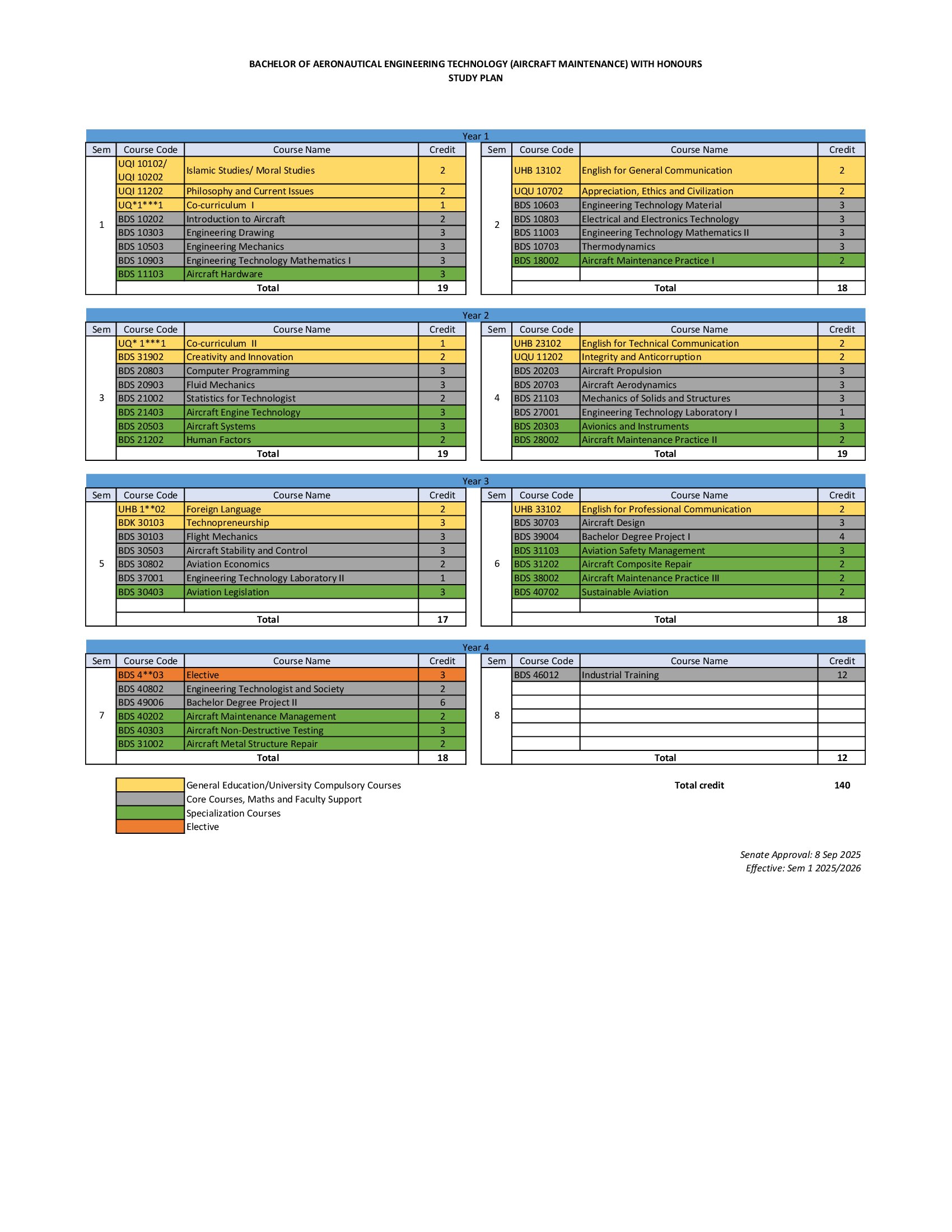
Curriculum

Ask Us

If you require any further information, please contact us.


Dr. Muhammad Faiz Bin Ramli

Head of Programme

Bachelor of Aeronautical Engineering Technology (Aircraft Maintenance) with Honours (BDM)

Department of Aeronautical Engineering

Faculty of Mechanical and Manufacturing Engineering

Email: This email address is being protected from spambots. You need JavaScript enabled to view it.

Ilmu itu dimiliki oleh lidah yang banyak bertanya, dan akal yang gemar berfikir

Abd Allah ibn Abbas